If you are reading this in a hallway with your phone in one hand, start here: do not lift them yet.
The instinct to get someone off the floor immediately is strong and completely natural. It is also the thing most likely to turn a bad situation into a worse one. A fracture or a head injury can be made considerably more serious by being moved before anyone knows it is there.
Take a breath. Here is the order to do this in.
The first ten minutes
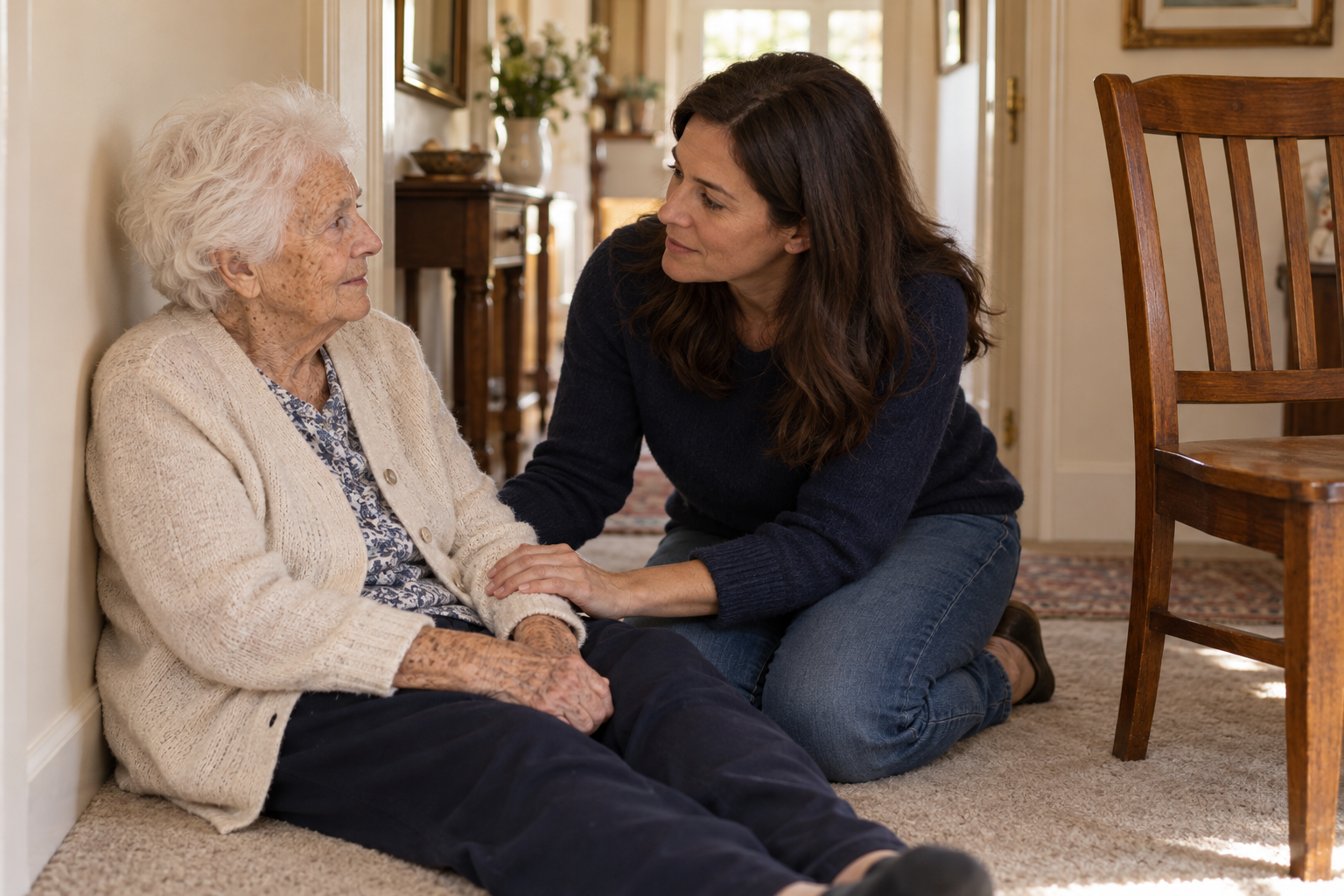
Get down to their level and talk to them. Do not shout from the doorway. Kneel where they can see your face.
Ask two questions before anything else. Where does it hurt? Did you hit your head?
Ask the second one even if you are fairly sure they did not. People frequently do not remember, and a head injury is the thing you cannot afford to miss.
Call 911 immediately if any of these apply
- Severe pain anywhere, or any pain in the hip, back or neck
- They hit their head, or you are not certain whether they did
- A limb looks misshapen, or they cannot put weight on it
- They are dizzy, confused, drowsy, or lost consciousness even briefly
- They cannot get up, even with help
- They are on blood thinners and hit their head, regardless of how they seem
- You are not sure
That last one is not padding. If you are standing there weighing it up, the answer is to call. Nobody has ever regretted calling an ambulance for a parent who turned out to be fine.
While you wait, keep them warm, keep them still, and stay with them.
If they are not injured, help them up in stages
Do not lift. You coach and steady, they do the moving. If you try to haul an adult off the floor you will hurt one or both of you.
- Let them rest on the floor for a few minutes first. There is no rush, and getting up too quickly causes a second fall.
- Bring a sturdy chair and place it beside them.
- Have them roll onto their side, then push up to sitting.
- Then onto hands and knees, facing the chair.
- Both hands on the seat. Bring the stronger leg forward so that foot is flat on the floor.
- Push up through that leg and both arms, turn slowly, and sit down.
- Rest again before standing.
If pain appears at any point, or they cannot manage a step, stop. Make them comfortable where they are and call for help.
If they cannot get up and are alone
Time on the floor matters. Lying there for hours causes dehydration, pressure injuries, breathing problems and a drop in body temperature, and those complications can be more dangerous than the fall itself. This is the strongest argument there is for a medical alert device for anyone living alone who has fallen before.
The next 48 hours
Even if the fall seemed minor, watch for:
- A headache that worsens
- New confusion, unusual drowsiness or personality change
- Nausea or vomiting
- Weakness, numbness, or trouble with speech or balance
- Pain that gets worse rather than better over a day or two
- Any new bruising, particularly around the head
Head injuries in older adults do not always announce themselves straight away. Bleeding can develop slowly over hours or even days, and the risk is considerably higher for anyone on blood thinners. Delayed symptoms are a reason to call a doctor, not a reason to wait and see.
Tell the doctor, even if nothing is broken
This is the step families skip most, usually because the fall turned out to be nothing and everybody wants to move on.
Do not skip it.
A fall is a symptom, not an accident. Very often something caused it, and that something is treatable. Common culprits include:
- Medication. Blood pressure tablets, sedatives, sleeping aids, antidepressants and anything new in the last month. Interactions between several prescriptions are a frequent cause.
- Blood pressure dropping on standing. Extremely common, easily tested, often fixable.
- An infection. In older adults, a urinary tract infection can present as confusion and unsteadiness with no other obvious symptoms.
- Dehydration, which is more common than families expect.
- Vision. An out of date prescription, cataracts, or new varifocals that change depth perception on stairs.
- Inner ear and balance problems.
- Weakness in the legs that has built up gradually.
- Foot pain, or unsafe footwear.
Go to that appointment with them, and bring the full list of everything they take, including anything over the counter. Ask directly: what caused this, and what can we do about it?
The part nobody warns you about
Here is what happens next in a very large number of families, and almost nobody sees it coming.
Your parent is fine. Nothing broke. Everyone is relieved.
And then they stop doing things.
They stop going down to the basement. Then they stop the morning walk, because the pavement is uneven. Then they stop going out in the evening. Each decision is sensible on its own and each one is made quietly, often without telling anybody.
This is fear of falling, and it is one of the most consequential outcomes of a fall that caused no physical injury at all.
The cruelty of it is that it creates exactly the outcome it is trying to avoid. Moving less means losing leg strength and balance. Losing strength and balance makes the next fall more likely, not less. Within a few months a person who was managing independently can be genuinely unsteady, and the first fall is the reason, even though it broke nothing.
Watch for it. If your parent has quietly stopped doing something they used to do, that is worth a conversation and often worth a referral to physical therapy. Rebuilding confidence and strength is a real, treatable thing, and it works much better early.
Why the next one matters more
Falls are not rare. Over 14 million older adults in the United States, about one in four, report falling each year. And the trend is going the wrong way: the age adjusted fall death rate for older adults rose 21 percent between 2018 and 2024, from 64.7 to 78.4 deaths per 100,000.
The practical point for your family is this. A first fall is the clearest warning you will get, and it is the moment when changes are easiest to make. Families who act after the first one usually keep their parent at home. Families who wait for the second one are frequently making decisions in a hospital corridor instead.
What to change this week
Walk the house at night. Not in daylight. Actually walk from the bed to the bathroom in the dark and see what they see. A lamp within reach of the bed and nightlights along the route fix a surprising proportion of falls.
Deal with the floor. Loose rugs, especially at doorways and the bottom of stairs. Extension cords across walkways. Stacked papers. Furniture that has crept into the path.
Put a real grab bar in the shower. A towel rail is not a grab bar. It will come out of the wall at the worst possible moment.
Look at the shoes. Slippers with no back, smooth soles, and walking around in socks are all common causes.
Watch how they get out of a chair. If standing takes two or three attempts, or they push off with both arms, that is lost leg strength and it is the most reliable warning sign of a future fall.
Ask about physical therapy. Strength and balance work genuinely reduces fall risk, and most families never think to ask for it.
Consider a medical alert device if they live alone, for the reasons above.
Our guide on the signs an aging parent needs help at home goes room by room through what else to look for.
When it is time for help at home
Not every fall means someone needs daily care. But some patterns do mean it, and these are the ones we hear most often:
- They have fallen more than once in the past year
- They cannot get up on their own
- They live alone and nobody would know for hours
- Mornings are the problem, because getting washed and dressed is when it happens
- They have become afraid, and are shrinking their world because of it
Cherished Home Services is a non-medical home care agency serving Virginia Beach and the greater Hampton Roads community. We help with the parts of the day where falls actually happen: bathing and dressing, moving safely around the house, getting to the bathroom at night, meals, and simply being there so nobody is on the floor alone for hours.
Care does not have to cover the whole day to make the difference. Most families start with the hardest hour.
Learn more about our services or request a free consultation.
Frequently asked questions
Should I call 911 if my parent falls but seems fine? Call if there is any pain in the hip, back or neck, any chance they hit their head, a limb that looks wrong or cannot bear weight, dizziness, confusion or drowsiness, if they cannot get up even with help, or if they are on blood thinners and hit their head. If you are unsure, call. An unnecessary ambulance is a far better outcome than a missed fracture or bleed.
How do I help an elderly person up after a fall? Only after establishing they are not injured, and never by lifting them. Let them rest on the floor first, bring a sturdy chair, and guide them to roll onto their side, push up to sitting, move onto hands and knees facing the chair, place both hands on the seat, bring the stronger leg forward, and push up to standing. Stop immediately if there is pain.
What should I watch for in the days after a fall? A worsening headache, new confusion or drowsiness, nausea, weakness or speech problems, and pain that increases rather than settles. Head injuries in older adults can develop slowly, especially for anyone on blood thinners, so delayed symptoms warrant a call to the doctor.
Why do older adults fall? Usually something treatable. Medication side effects and interactions, blood pressure dropping on standing, infections, dehydration, vision changes, balance problems and gradual leg weakness are all common causes. This is why a fall should always be reported to a doctor, even when nothing is broken.
My parent is scared to walk now. Is that normal? Very common, and worth addressing rather than accommodating. Fear of falling leads people to move less, which costs strength and balance, which makes another fall more likely. Physical therapy to rebuild confidence and strength works well, and works better the earlier it starts.
How common are falls in older adults? About one in four older adults, more than 14 million people in the United States, report a fall each year, and the fall death rate has been rising. A first fall is the strongest warning a family gets that something needs to change.
Useful resources
National Council on Aging, Falls Prevention Free evidence based fall prevention programmes and a falls risk self assessment. ncoa.org/older-adults/health/prevention/falls-prevention
CDC STEADI (Stopping Elderly Accidents, Deaths and Injuries) Checklists and guidance for families and clinicians, including a home safety checklist. cdc.gov/steadi
Virginia Department of Health, Fall Prevention State level programmes and local referrals. vdh.virginia.gov
VirginiaNavigator and SeniorNavigator A searchable directory of services for older Virginians, organised by locality. virginianavigator.org · seniornavigator.org
Area Agency on Aging Your local agency can advise on home safety assessments, grab bar installation programmes and balance classes. Your city’s Department of Human Services can point you to it.
If this week has been frightening
It usually is. A fall changes how a family sees the situation overnight, and the decisions that follow are rarely easy ones.
If you want to talk through what your parent actually needs, we are here in Hampton Roads and there is no cost for the conversation.
Request a free consultation or call (757) 220-2396.
This article is general information and is not medical advice. Cherished Home Services LLC is a non-medical home care agency and does not provide nursing or medical treatment. In an emergency, call 911. Any fall should be reported to the person’s doctor, even when there is no apparent injury.
Sources: Centers for Disease Control and Prevention, Older Adult Falls Data; Lifeline, What to Do When an Older Adult Falls.